Sunday, March 23
A New Beginning
It's been weeks since I've posted on this week and while I sort of grew into the name "Sassy & Hip", it's time to move on. Just as I graduated high school, I'm in a way also graduating from this blog?
You can find me now at ARTICLES OF FASHION, in a few months I'll re-direct this page straight to my new blog. But in the mean time if you could all check it out, I have a few new posts up and also "like" my new facebook page (facebook.com/articlesoffashion) that would be great!
So here's to a new beginning and many more exciting things in the future!
Saturday, January 25
Let's Just Move it Along
| Prada Fall/Winter 1998 Campaign Source: http://styleregistry.livejournal.com/ |
I've struggled to write a post for some while now, but it's not because I'm out of ideas, it's simply because I can't keep up. The fashion schedule is as busy as it's ever been starting the year with menswear then couture and then fall collections and then before you know it there are the inter-seasonal collections followed by spring collections and the cycle the repeats itself. I took some time out from writing about fashion to really reflect on what I wanted to make this blog into as well as reflect on the fashion year which had just passed. Generally speaking, a year is a long time but, from what I discovered during this time is that a year in fashion is chaotic, exhausting and most of all, short-lived. There's no time for celebration anymore. Every season, after months and months of preparation, a 15 or so minute fashion takes place and then it's onto the next season. The experience of fashion has been cheapened as we are presented with 'yeah, that's ok' instead of 'the next truly great thing.'
Fashion is cherished because it's always reinventing itself. Sprawled across the glossy magazines you find at the checkouts of supermarkets is what fashion is stereotyped and summarised into; the 568 must-haves for summer. But really, who needs 568 new things for a season? This constant need of something new and reinvigorating has become a disease. A disease created by us. It's not viewed as a want but, a need, a sense of entitlement to something brand new and unexpected. Yet as fashion progresses forward with every season, what happens to last season?
We don't really think about last season anymore. I mean we really don't even have time to because of the immensely chaotic fashion schedule. We cherish those truly iconic moments in the past and that's about it. Because, really, who cares about what Miuccia did last season right?
It's quite saddening to see fashion lovers and enthusiasts forget what someone did last season because they've just presented a whole new collection. Even the term "last season" has become laced with negative notes of dismissal and denigration. Last season collections are simply disregarded with absolutely no respect because you must simply stay "in" fashion darling. This happens too often as countless brilliant "last season" collections fall victim to this disease of needing the new. Although we fashion connoisseurs aren't just to blame, the media refuses to report on designers past achievements, only the present.
Some may argue that this really shouldn't be a problem in fashion as fashion is obsessively moving forward but, what happens to the future if we don't acknowledge the past?
While a large part of this concerns collections, even sadder, great designers of the past and their work are short-lived. What remains are coffee-table fashion books published by Taschen or Phaidon praising their legacy and work through a few hundred photo-filled pages and a short essay on the subject. Even now, Christian Lacroix just seems like a forgotten memory.
There is no respect for true fashion or true genius but instead, the amount of collections produced and the amount of progression brought to the table by a designer. Fashion wants to constantly move forward - no matter the cost.
So, let's just move it along because the past is just a thing of the past, right?
Thursday, December 5
The Circus of Fashion
| Before Valentino F/W 2013 photographed by Adam Katz Sinding of Le 21 Eme |
“Blog is such a dirty word,” Leandra Medine aka the Man Repeller said it and I agree. When I started “blogging” it was around February/March of this year, I had little to no experience in writing about fashion. It was at this time the now infamously contentious article, “the Circus of Fashion” by Suzy Menkes surfaced. At the time I didn’t want to write about this issue because I felt I had no place. I had no authority nor credibility to write about the article and you could even argue that to this day and forth until I receive formal education in relation to fashion writing, I have no place and serve no purpose in the fashion industry. However, as the year ends and a new one begins, I feel as though I have matured both in words and my opinions of the fashion industry. The Circus of Fashion was an exceptional piece as it forced people to discuss the changing nature of the fashion industry and more importantly, the role of “bloggers” in fashion. The Circus of Fashion started a conversation that was well overdue.
You cannot deny that the Circus of Fashion serves up the brutal truth about the changing ways of the fashion industry. So brushing off Menkes as a “hater” of sorts would be juvenile and even disrespectful. The article surrounds the issue that in fashion there are indeed, show-offs – those who dress for the attention or the genuinely stylish. I think whilst this may be true to an extent, applying these two labels to the fashion industry directly opposes the liberal doctrine of fashion. I have said it before and I will say it again, fashion is supposed to be liberal. It shouldn’t be governed by laws or rules or regulations. No one should be able to say how low the hem of your skirt should be (here’s looking at you high school) or that you can’t wear jeans and runners together (yes I went there). Fashion serves a purpose for everyone, whether you’re aware of it or not, you are in fact a part of the fashion industry even if you don’t consider yourself “fashionable.” In any case, the genuinely “stylish” as Menkes refers to them may in fact be the show-offs. So what is style? Can you see it? Can you feel it? How do you describe it?
Style is a social and psychic concept. Social because we do not constitute ourselves on our own, we rely on our social interaction with others to form opinions, theories and ideas. However social concepts do not instigate themselves by their own accord, they are a consequence of the interplay between the subject and the world around them. Thus the psychic concept is a sub-concept of the social one, analysing the social concept to create a psychic one in which our ideal sense of style is born. Therefore, the concept of style is really one of individual as well as communal accord and I don’t believe it’s up to anyone, even Menkes, to dictate the definition of “stylish”. Furthermore, you can equate the concept of style and the stylish with the “show offs”. Most of those labelled as “show offs” are just serving up their bespoke definition of style in perhaps a more flamboyant fashion than those serving up the “understated chic”. I don’t believe that flamboyancy should be equated with the label of a “show off”, it carries negative connotations and therefore allows room for misinterpretation. Especially when those given the label of a “show off” are underserving of it, which points to another issue associated with the Circus of Fashion, respect.
Like it or not, the fashion media/press now includes bloggers. Be it Susie Bubble or Bryanboy, these people carry more influence in fashion than celebrities now. And you have them to thank for the top tier fashion labels’ presence on social media. Brands no longer want to be exclusive but want to appear accessible to a wider audience. Democracy. Digital media, through sites such as Style.com, NowFashion, bloggers and more make it possible for anyone to peek inside the enigmatic world of the fashion industry. But now too many bloggers are toting around their Céline Luggage bags as if there’s no tomorrow and have created a false interpretation of the industry of fashion bloggers. While it is most certainly true that bloggers receive gifts, trips to exotic locations paid for by the brand they’re campaigning and much more, it’s rare that bloggers are paid based on their merit over social media influence. I remember a while ago one of my friends asked me when I was going to start making money from my blog and honestly I was quite shocked. There was this expectation that I had to start profiting from my blog. I’ll be transparent, I’ve been contacted already by companies to become an advertiser and even allow companies to write posts on my blog but I’ve said no. The role of the fashion media is not to represent the paid views of others but be respected as a reputable opinion or source. And now we’ve come full circle back to respect.
So what are bloggers? Are they journalists? Editors? Creative directors? Stylists? In order to discuss the idea of respect in relation to bloggers, personal branding plays an important role in the development of respect. How they portray themselves and how this image and/or brand is perceived by others. Professionalism has always been at the forefront of reputable fashion media. However, professionalism is usually compared to formality. Depending on how a blogger brands themselves, you’ll usually see that blogs suffer from formality – that is however not to say that blogs suffer in the field of professionalism. You can be professional and not formal. Blogs have been long characterised as informal, to appear more accessible and approachable to everyone and anyone. They often represent raw and unedited opinions, which is really a scary thought in an industry where image and reputation is everything. Perhaps that is why the fashion media has been unwelcoming to bloggers. Although bloggers may be informal and professional, and may not hold the title of an “Editor in Chief” or “Journalist”, bloggers deserve the same respect as the rest of the fashion media and not to be minority who are scrutinized by fellow members of the fashion media.
Yet this issue lies not entirely at the hands of those reputable members of the fashion media, but also with bloggers themselves. Both the amateur and the veteran bloggers are to blame for the standards, expectations, misunderstandings and inaccurate representation of bloggers.
It’s time we all took time out to reflect on our personal brands and images we are trying to create in order to destroy this fun-house image of the fashion mob. Myself included.
This will be my last post for 2013 but I will be back in 2014 with a new blog layout, logo and title as this space continues its endeavour to bridge the gap between fashion as an industry, medium of creative expression and intellectual force. Whilst many things may change in this space during the coming months, this space will always represent my voice within the fashion industry.
Sunday, November 24
Australia's New Retail Landscape
| Chanel's new Melbourne flagship boutique Source: Broadsheet.com.au |
On a global platform, Australia has always struggled to synchronise it's seasons and trends every year because of it's geographical positioning within the Southern Hemisphere. Therefore domestically, our own Australian fashion industry has fought for it's international recognition. The truth is that we're always behind but, we can't help it because of the opposite seasons and because geographically Australia is positioned so far from the most influential cities of fashion - New York, Paris, London and Milan. And although we could potentially create our own niche of a fashion industry, the Australian textile and garment industry is simply too small. Most Australian consumers purchase their clothing from local commercial retail stores such as Cotton On, Sportsgirl or Factorie and all of these companies outsource their production to countries such as China or Bangladesh. The Australian fashion industry is becoming smaller and smaller everyday as imported brands takeover the cities of Melbourne and Sydney, leaving no choice for home-grown brands to either sell out and become commercially viable or leave the fashion industry all together.
Over the last few years, living in the city of Melbourne, I've seen the influx of international stores and brands open stores in and around Melbourne. International designer brands arrived in Melbourne with the opening of stores such as Marais and Assin, both opening in 2004. While these two stores are distinctly different in their interiors and accompanying offerings, they share the same philosophy of exclusivity - both are hidden away from the prosaic city of Melbourne, offering an oasis for those who know where to look. Although Chanel has been a part of Australia's luxury retail market since 1988, being represented by a single store in Sydney until 2001, it's new flagship store in Melbourne is a sign of the changing retail landscape in Australia. The new Chanel store in Melbourne boasts a total of 4 levels, 2 of which are dedicated to providing the best shopping experience for it's customers. Dior's newly opened boutique in Sydney is also a sign of international brands investing in the success of the Australian retail market. Yet these brands are only a part of the growth of international labels, stores and designers Australia has seen in the past few years.
GAP was the first major international retailer to expand into Australia in 2010. Following this Zara opened it's doors in Australia in 2011, and currently have a total of 8 stores in Australia - most of them in either Victoria or New South Wales. While Topshop also expanded into Australia in 2011 and now own 4 stores with flagships in Victoria and New South Wales. H&M also announced it's decision earlier this year to open it's first Australian store next year at GPO in Melbourne and Uniqlo will be set to open a multi-level store in Melbourne's Emporium around April 2014, planning a number of stores to be opened within weeks after it's store in Emporium. These retailers are eyeing the possibility of global expansion and with their resources as some of the most powerful and largest international retailers in the world, the Australian market will soon become a tempting statistic for other international retailers wanting to achieve the same goal. While the Australian market becomes dominated by some of the most powerful players within the international retail market, this ultimately will force Australian retailers to compete with the availability and affordability of garments. Inevitably, Australian retailers such as Sportsgirl (a retailer who used to "borrow" ideas from Topshop) will be forced to become more efficient, original and affordable but in reality, Sportsgirl who has an impressive outreach within Australia, cannot compete with international retailers such as Zara backed by Inditex, the largest retailer in the world, who reported the Australian market as their most profitable. Sure, you can argue that many will buy Australian brands over international but when push comes to shove consumers will always be concerned with the two factors of affordability and availability over anything else - the two factors which are the most basic fundamentals of retailers such as Zara and H&M. Yet this is not the only monopoly international retailers hold over Australian retailers. Zara has an international following which equates to an international reputation. Sportsgirl has a small Australian following, reputation and it's target demographic is also extremely limited when compared to Zara's. Therefore as Australian consumers choose international over domestic, don't be so surprised when you see a decrease in the amount of Australian retailers continuing to operate successfully within the market.
Whilst the number of international brands have continued to successfully emerge in the Australian market, it has forced many designers to either sell out or leave the fashion industry altogether. In this past year alone, the Australian fashion industry has seen designers Lisa Ho and Kirrily Johnston being forced into administration. Lisa Ho's brand went under administration after having recorded a loss of $2.4 million and a debt of up to $11 million and less than a month after Johnston announced her decision to place her business in the hands of administrators. Johnston reportedly blamed a mixture of the GFC and manufacturing bad luck for the closure of her business. However, this was only the beginning of the demise of Australian fashion designers as Alannah Hill, Kit Willow and Collette Dinnigan all left their brands and consequently the industry. Although Dinnigan's official reason for leaving the fashion industry was to "free up time" to spend with her child and had no debt, it is a shame as she was the first Australian designer to ever show at Paris Fashion Week. Willow and Hill however have not stated reasons for leaving their eponymous brands. All the while, co-founders of Sass & Bide, Sarah-Jane Clarke and Heidi Middleton resigned as directors of their brand after Myer purchased the remaining 35% of shares, making Myer the sole shareholders of Sass & Bide. Thus, Sass & Bide, is now more than ever, becoming a commercially viable high-end brand. As the number of successful Australian designers and brands continues to diminish the question becomes if the Australian fashion industry will be able to sustain itself and it's consequent domestic retail market.
GAP was the first major international retailer to expand into Australia in 2010. Following this Zara opened it's doors in Australia in 2011, and currently have a total of 8 stores in Australia - most of them in either Victoria or New South Wales. While Topshop also expanded into Australia in 2011 and now own 4 stores with flagships in Victoria and New South Wales. H&M also announced it's decision earlier this year to open it's first Australian store next year at GPO in Melbourne and Uniqlo will be set to open a multi-level store in Melbourne's Emporium around April 2014, planning a number of stores to be opened within weeks after it's store in Emporium. These retailers are eyeing the possibility of global expansion and with their resources as some of the most powerful and largest international retailers in the world, the Australian market will soon become a tempting statistic for other international retailers wanting to achieve the same goal. While the Australian market becomes dominated by some of the most powerful players within the international retail market, this ultimately will force Australian retailers to compete with the availability and affordability of garments. Inevitably, Australian retailers such as Sportsgirl (a retailer who used to "borrow" ideas from Topshop) will be forced to become more efficient, original and affordable but in reality, Sportsgirl who has an impressive outreach within Australia, cannot compete with international retailers such as Zara backed by Inditex, the largest retailer in the world, who reported the Australian market as their most profitable. Sure, you can argue that many will buy Australian brands over international but when push comes to shove consumers will always be concerned with the two factors of affordability and availability over anything else - the two factors which are the most basic fundamentals of retailers such as Zara and H&M. Yet this is not the only monopoly international retailers hold over Australian retailers. Zara has an international following which equates to an international reputation. Sportsgirl has a small Australian following, reputation and it's target demographic is also extremely limited when compared to Zara's. Therefore as Australian consumers choose international over domestic, don't be so surprised when you see a decrease in the amount of Australian retailers continuing to operate successfully within the market.
Whilst the number of international brands have continued to successfully emerge in the Australian market, it has forced many designers to either sell out or leave the fashion industry altogether. In this past year alone, the Australian fashion industry has seen designers Lisa Ho and Kirrily Johnston being forced into administration. Lisa Ho's brand went under administration after having recorded a loss of $2.4 million and a debt of up to $11 million and less than a month after Johnston announced her decision to place her business in the hands of administrators. Johnston reportedly blamed a mixture of the GFC and manufacturing bad luck for the closure of her business. However, this was only the beginning of the demise of Australian fashion designers as Alannah Hill, Kit Willow and Collette Dinnigan all left their brands and consequently the industry. Although Dinnigan's official reason for leaving the fashion industry was to "free up time" to spend with her child and had no debt, it is a shame as she was the first Australian designer to ever show at Paris Fashion Week. Willow and Hill however have not stated reasons for leaving their eponymous brands. All the while, co-founders of Sass & Bide, Sarah-Jane Clarke and Heidi Middleton resigned as directors of their brand after Myer purchased the remaining 35% of shares, making Myer the sole shareholders of Sass & Bide. Thus, Sass & Bide, is now more than ever, becoming a commercially viable high-end brand. As the number of successful Australian designers and brands continues to diminish the question becomes if the Australian fashion industry will be able to sustain itself and it's consequent domestic retail market.
The retail landscape in Australia is changing and it's becoming more international than ever before. And the international takeover is far from complete as more international brands and retailers continue to profit from their investment in the Australian retail market, more retailers and brands will soon follow. Thus forcing Australian retailers to either move over or compete with international retail standards of affordability and accessibility. It's a shame but the reality is that it's happening and consumers should all watch this space as it marks the start of a completely new retail industry for Australia.
Friday, November 22
Fashion News: Some Things You May Have Missed...
So while I was busy studying super super hard for my exams, so many things happened! I thought I would just take an opportunity to cover just some of the many things that you may have missed in my absence! Perhaps, I may even make this a weekly thing!
Nicolas Ghesquière appointed Creative Director of Louis Vuitton.
All the speculation paid off! In my eyes, this really is a better fit for the brand as Louis Vuitton continues to re-brand itself to stay current, modern and fresh. Ghesquière is personally, one of my all time favourite designers. He knows how to design and he knows how to do it well. More importantly, Louis Vuitton in the last few years is trying to stray away from it's monogrammed culture. Louis Vuitton under the creative control of Ghesquière will no doubt provide a new and improved platform of creative expression for both the house and Ghesquière himself. Also now that Ghesquière is working for LVMH, Bernard Arnault will no doubt provide the resources to fight the lawsuit which PPR (the luxury conglomerate which owns Balenciaga) initiated against Ghesquière. Now it just seems like a bad idea on PPR's behalf because we all know LVMH is much more powerful and it's resources are much more widespread than PPR. So a big congratulations to Nicolas Ghesquière and I'm sure many are eager to see his debut collection at Louis Vuitton.
Sarah-Jane Clarke and Heidi Middleton's resignation as directors of Sass & Bide.
In all honesty, I really wasn't surprised at this news. Ever since Myer bought shares in Sass & Bide, the company has become more and more commercial - they've recently expanded into lingerie. When a chain department store as big as Myer has it's eyes set on a company, it's not because they really 'believe' in the brand, but rather because they know that the brand can become commercially accessible and become a source of revenue. Sass & Bide now will be a company aimed at mass appeal rather than creating designs as a source of creative expression. However that's not to say that Clarke and Middleton won't have any control of the brand, they will be staying on as brand director and creative director of Sass & Bide as well as being the public ambassador's of the brand.
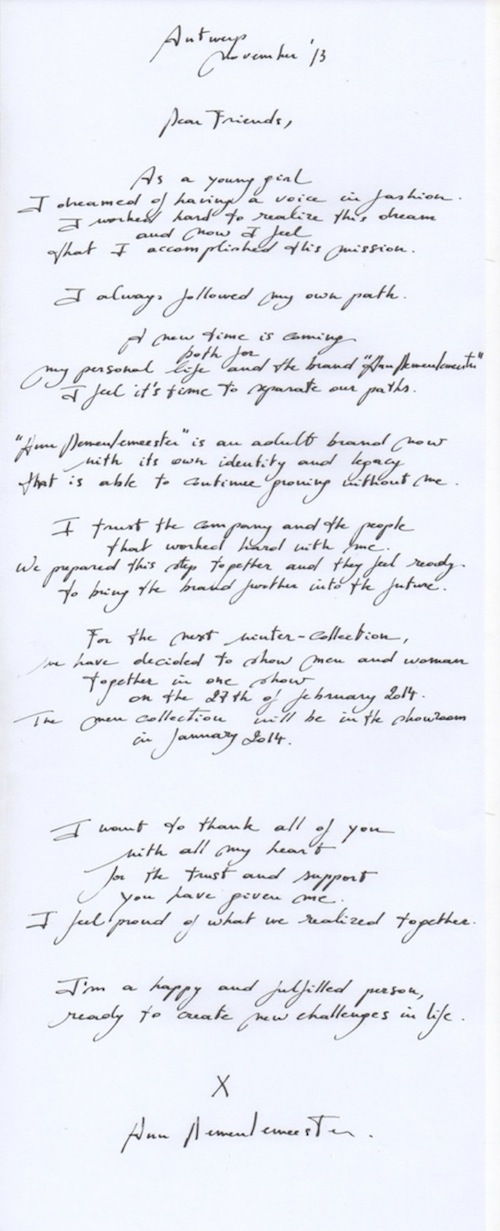
Ann Demeulemeester leaving her eponymous label.
I first heard about this at about 2:50am today (right after seeing the midnight premiere of The Hunger Games Catching Fire) and honestly I don't know if it was the fact that it was nearly 3 in the morning and I had been running around all day or something else but my heart honestly sunk when I read the email from Business of Fashion announcing her exit. Demeulemeester's exit is sad in itself but also when viewed in the larger sense represents the changing landscape of the fashion industry on a global scale. Of course she will never be replaced, no matter who next holds the helm at her eponymous label, the label will never be the same and the die-hard Demeulemeester fans all know that. She is one of the infamous Antwerp Six, starting from humble beginnings, Demeulemeester has successively transformed her previously underground dark romantic aesthetic into one which is now embraced by so many in the fashion industry (Read: Mining the Goth Aesthetic, Fashion Pivots to Darkness). In my opinion, there are two types of designers; the first is the one which just makes pretty clothes - sticks to the status quo and the second which is revolutionary - challenges the audience's preconceptions. Demeulemeester is one of those rare designers who are truly revolutionary.
Read the letter she has penned regarding her exit here.
Kit Willow pushed out by the Apparel Group from Willow.
Money, Greed or simply a misunderstanding? I'm honestly not too sure what's happening there. The Apparel group owns Saba and Sportscraft - two well-respected brands within the Australian fashion industry, however they're really nothing too revolutionary or anything we haven't seen before. Willow however, is the most influential label which the Apparel Group owns. It's extremely hard in the fashion industry to stay true to one's oeuvre, especially in the Australian fashion industry where it is hard to succeed because up until a few years, we've cherished our mass-appeal and commercial brands more than anything. Australia as a nation is quite lazy? I suppose that's a good way to describe it. We're constantly behind in trends and new developments in industries whether it be the fashion industry or technology. It's always sad to see a designer pushed out of their own label that they've grown and one which bears their name - it's very much a David and Goliath situation. However, I doubt that anything too drastic will happen to the Willow label in the coming years. The whole incident will simply be brushed under the carpet as by the Apparel Group as they strive to reach new goals and sales targets for the Willow label.
Uniqlo sets it's sights on Melbourne.
Uniqlo has set a goal to become the number fast retailing company in the world. As it stands today, it is currently #4, after Zara, H&M and GAP. Currently Uniqlo holds an impressive brand portfolio of J-Brand, Helmut Lang, Comptoir des Cotonniers among others. Uniqlo is one of the stores I truly admire in the fast-retail industry because of it's strong sense of identity and direction. Uniqlo has an impressive Corporate Social Responsibility program, one of which puts companies such as H&M and Primark to absolute shame. One of the programs they've recently put to use is their Grameen initiative - they give back to the people and in particular women of Bangladesh, one of the countries exploited by textile manufacturing by companies such as Primark and H&M after the factory collapse in November of last year. Uniqlo has ventured into global expansion by two major factors; organic growth and quality in both their products and services. Uniqlo is a company which is truly Japanese in the core of their business model but is also successively expanding and adapting to the conditions of a global economy.
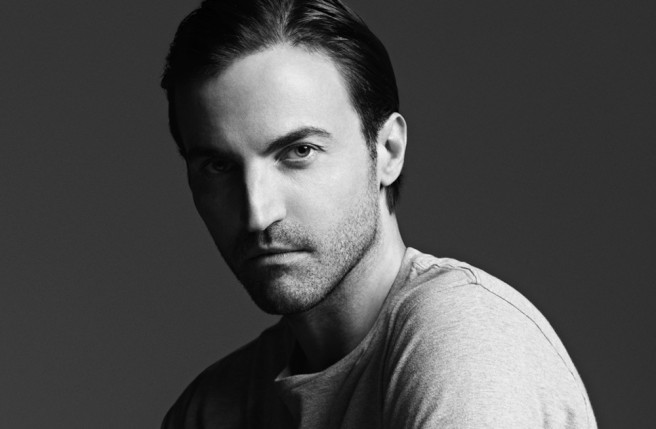
| Nicolas Ghesquière photographed by Karim Sadli Source: Business of Fashion |
Nicolas Ghesquière appointed Creative Director of Louis Vuitton.
All the speculation paid off! In my eyes, this really is a better fit for the brand as Louis Vuitton continues to re-brand itself to stay current, modern and fresh. Ghesquière is personally, one of my all time favourite designers. He knows how to design and he knows how to do it well. More importantly, Louis Vuitton in the last few years is trying to stray away from it's monogrammed culture. Louis Vuitton under the creative control of Ghesquière will no doubt provide a new and improved platform of creative expression for both the house and Ghesquière himself. Also now that Ghesquière is working for LVMH, Bernard Arnault will no doubt provide the resources to fight the lawsuit which PPR (the luxury conglomerate which owns Balenciaga) initiated against Ghesquière. Now it just seems like a bad idea on PPR's behalf because we all know LVMH is much more powerful and it's resources are much more widespread than PPR. So a big congratulations to Nicolas Ghesquière and I'm sure many are eager to see his debut collection at Louis Vuitton.
Sarah-Jane Clarke and Heidi Middleton's resignation as directors of Sass & Bide.
In all honesty, I really wasn't surprised at this news. Ever since Myer bought shares in Sass & Bide, the company has become more and more commercial - they've recently expanded into lingerie. When a chain department store as big as Myer has it's eyes set on a company, it's not because they really 'believe' in the brand, but rather because they know that the brand can become commercially accessible and become a source of revenue. Sass & Bide now will be a company aimed at mass appeal rather than creating designs as a source of creative expression. However that's not to say that Clarke and Middleton won't have any control of the brand, they will be staying on as brand director and creative director of Sass & Bide as well as being the public ambassador's of the brand.
Ann Demeulemeester leaving her eponymous label.
I first heard about this at about 2:50am today (right after seeing the midnight premiere of The Hunger Games Catching Fire) and honestly I don't know if it was the fact that it was nearly 3 in the morning and I had been running around all day or something else but my heart honestly sunk when I read the email from Business of Fashion announcing her exit. Demeulemeester's exit is sad in itself but also when viewed in the larger sense represents the changing landscape of the fashion industry on a global scale. Of course she will never be replaced, no matter who next holds the helm at her eponymous label, the label will never be the same and the die-hard Demeulemeester fans all know that. She is one of the infamous Antwerp Six, starting from humble beginnings, Demeulemeester has successively transformed her previously underground dark romantic aesthetic into one which is now embraced by so many in the fashion industry (Read: Mining the Goth Aesthetic, Fashion Pivots to Darkness). In my opinion, there are two types of designers; the first is the one which just makes pretty clothes - sticks to the status quo and the second which is revolutionary - challenges the audience's preconceptions. Demeulemeester is one of those rare designers who are truly revolutionary.
Read the letter she has penned regarding her exit here.
Kit Willow pushed out by the Apparel Group from Willow.
Money, Greed or simply a misunderstanding? I'm honestly not too sure what's happening there. The Apparel group owns Saba and Sportscraft - two well-respected brands within the Australian fashion industry, however they're really nothing too revolutionary or anything we haven't seen before. Willow however, is the most influential label which the Apparel Group owns. It's extremely hard in the fashion industry to stay true to one's oeuvre, especially in the Australian fashion industry where it is hard to succeed because up until a few years, we've cherished our mass-appeal and commercial brands more than anything. Australia as a nation is quite lazy? I suppose that's a good way to describe it. We're constantly behind in trends and new developments in industries whether it be the fashion industry or technology. It's always sad to see a designer pushed out of their own label that they've grown and one which bears their name - it's very much a David and Goliath situation. However, I doubt that anything too drastic will happen to the Willow label in the coming years. The whole incident will simply be brushed under the carpet as by the Apparel Group as they strive to reach new goals and sales targets for the Willow label.
Uniqlo sets it's sights on Melbourne.
Uniqlo has set a goal to become the number fast retailing company in the world. As it stands today, it is currently #4, after Zara, H&M and GAP. Currently Uniqlo holds an impressive brand portfolio of J-Brand, Helmut Lang, Comptoir des Cotonniers among others. Uniqlo is one of the stores I truly admire in the fast-retail industry because of it's strong sense of identity and direction. Uniqlo has an impressive Corporate Social Responsibility program, one of which puts companies such as H&M and Primark to absolute shame. One of the programs they've recently put to use is their Grameen initiative - they give back to the people and in particular women of Bangladesh, one of the countries exploited by textile manufacturing by companies such as Primark and H&M after the factory collapse in November of last year. Uniqlo has ventured into global expansion by two major factors; organic growth and quality in both their products and services. Uniqlo is a company which is truly Japanese in the core of their business model but is also successively expanding and adapting to the conditions of a global economy.
Thursday, November 21
A Conversation with Georgina Santiago
Here she talks about colour, aesthetic, beauty as well as the two genres of fashion and art.
A: Beauty which disturbs is much more interesting than the “plain” beauty. It holds a special power – the ability of excogitation, to really challenge others to think.
I believe beauty has much more to say than to just propose a universal standard of beauty. It has the ability to carry much more depth and extend further. A certain form of ugliness has the ability to give beauty more depth and an element which brings it to the next level. In my opinion this particular aesthetic is truly satisfying once you have passed its first impact, which is kind of sour, however, it gets addictive, and eventually you are consumed, leaving you wanting more. At least it sticks to your memory much more than a simply “nice” image – which you probably will forget.
I have always been curious about people’s subjective tastes. Why is it that someone would love something and others would hate it? We all have some opinions without reason, but we are completely sure about them; we justify them as a part of our subjectivity. That is why it is always going to be a platform of discussion, because beauty is a social statement.
Although you’ve been formally educated as a fashion designer, you never refer to yourself exclusively as a designer, rather as a visual artist. Does the label of a designer perhaps provide somewhat creative boundaries or limitations to you as an artist?
Yes, I do think so. I am more interested in analysing, forecasting and collaborating in the aesthetics that society creates apart of its own identity, rather than solving problems, which I believe design must do. Design contributes to the aesthetics of an era. At first glance, design provides the solutions to a problem, and then communicates the appropriate aesthetic. This is why I don’t see myself as a designer, because I am more focused in the latter.
The two genres of art and fashion have never co-existed in a peaceful state. Some believe that fashion is not art and that art is not fashion on the basis that the wearability and pragmatism of each genre differs from the other. Do you believe there is a definitive answer as to whether fashion and art are able to co-exist as each-other? What is your opinion on the coexistence of fashion and art? Do you believe fashion is art or that art can be fashion?
I do believe that fashion can be art. However, that does not mean it necessarily is. Personally, I believe that there are three kinds of fashion.
The first is the type which exists on runways. This can definitely be art however not all runway fashion is art. Some of them are extremely luxury orientated. The second is the art that creates forms around the human body, in a sculptural sense, which is placed in museums (or more art-y runaways). This one is much closer to art. And the last one is fashion in the streets. It is the one which defines the parameters of fashion of a particular era. Personally, I believe that this is the one which is much closer to design, but at the same time the one that is much closer to art, because of its social aspect. These three kinds of fashion conjoined are cyclical; the last one is the starting and ending point. In my opinion fashion and art will definitely always feed each other.
Some would associate your work with minimalism because of the simplistic nature of your garments, however, would you rather label your work as challenging surrealism?
I am not sure if I would label it as a definitive definition, but it some ways it could be challenging surrealism. While I am working on it, I of course, think about pure forms, as minimalism encourages. A clear message, given by visual shapes that capture the attention for its simplicity, as an easy reading message, is a must to explain abstract and difficult concepts.
Personally I believe that sometimes trends in fashion can be a waste of money, that they are only beneficial towards marketing products and creating a sense of hysteria among consumers for the sole reason of generate a profit. It is why I much prefer to use the term aesthetic, as it holds a much liberal philosophy – it encourages people to become subjective about the trend or aesthetic. What do you think about my opinion? Do you believe that there is a distinction between trends and aesthetics in art, design or fashion?
I agree to an extent, however at the same time I don’t think trends are created for consumerism. I think trends would exist regardless of consumerism. Trends are an intrinsic aspect of society, as there are synergies between humans. At the same time, the fashion industry does take advantage of this, and accelerates the process and life of a trend. Aesthetics are much more general, and trends are not always aesthetic trends.
Minutiae and Vitrine both address the human body as a canvas or medium of creative expression. Although Minutiae portrays the body in a ‘sinister’ light, and Vitrine contends the mutation of the human body. Both of these carry negative connotations, however in both collections, your work not only accentuates the beauty of the human body but discredits the negative implications of cynicism and alteration. In the grand scheme of things, do you believe that perhaps sometimes the human body is taken for granted and we are not appreciative of its beauty?
I think I am so focused on the body because it is the material that we are made of, our shape, our physical aspect. The creation of an entity. How nature has decided us to be.
Furthermore, it has been on my mind, the way in which society perceives the female body to be beautiful. I have always hated this sort of “alteration”. For instance, the more sensual the female body is portrayed, the more beauty conveyed. For me, these are stupid equalisations which society has built, and I criticise them in my work. I would never present a woman in a sensual or glamorous way.
Through your projects Minutiae, Vitrine and the C&A design challenge; it becomes apparent that colours are extremely important to you. The palette of your work is very much focused on soft, pastel colours. Although in your design for the C.A. design challenge, you encompassed a rather vivid pink colour, you hid that away under the pleats of the garments so that its existence was dependent on the presence of light. The colours that you choose are always soft and aesthetically pleasing, never harsh when juxtaposed with your works Minutiae and Vitrine, do they perhaps provide a sense of balance between the unpleasant and the pleasant? Why do you believe colours are so important and powerful?
You are right, and I actually don’t choose those colours for this reason, but because they tell me something and in some cases are related directly to the concept, like in Minutiae.
I am a completely passionate about colour, and my language is colour. The fact that it is an aspect which every single thing in life bears makes it so powerful, and also the abstract side of it is so intriguing. It's communicative power is awesome; a colour has the ability to convey as much as an image does sometimes, and what it conveys is all socially constructed. The fact that colours are symbols is so amazing, given that humans have a really bad colour memory. I just love it!
As an artist, who is a person/(s) that you have the most admiration for and why?
I admire all the creative people that had done something meaningful. From Yves Klein, through Martin Margiela, to Lady Gaga. I could say so many...
Are you perhaps interested in branching out into transdisciplinary design, as trend analyses embraces a range of different artistic and design disciplines and your collections both involve the biological aspect of the human body?
Yes, definitely! I love all kinds of design, art, and creative forms, all manifestations of aesthetics. My aim is to work with something in between all of them.
Can you tell us about your next project? What does it involve and what are you intentions for it?
My next project is born from the Tumblr I have been curating for more than 3 years already, magneticum.tumblr.com. It is a selection of creative things which I have found interesting and aesthetically innovative.
I once said that my aim in life was to be inspired and inspire others – so I decided to make it happen. I am expanding my Tumblr to a website by adding more categories as well as more content to become a real source of inspiration for creative minds. Now magneticum will be an insight into my next project, theinspirationprovider.com. It’s exactly what I want to be, an inspirer.
Tuesday, October 29
Hi everyone!
So you may have noticed that there has been a complete lack of posts within the last month or so, I'm so sorry about that! I'll also be taking a short hiatus from today (29th Oct) until 18th Nov as I have my final high school exams.
I promise as soon as I finish my exams, I'll be blogging obsessively non-stop! So check back during mid-November, I have some really great and exciting posts planned for Sassy & Hip!
Have a great day and thank you so much for reading my blog!
Adeline xxxx
So you may have noticed that there has been a complete lack of posts within the last month or so, I'm so sorry about that! I'll also be taking a short hiatus from today (29th Oct) until 18th Nov as I have my final high school exams.
I promise as soon as I finish my exams, I'll be blogging obsessively non-stop! So check back during mid-November, I have some really great and exciting posts planned for Sassy & Hip!
Have a great day and thank you so much for reading my blog!
Adeline xxxx
Wednesday, October 16
Christopher Bailey's reign over Burberry
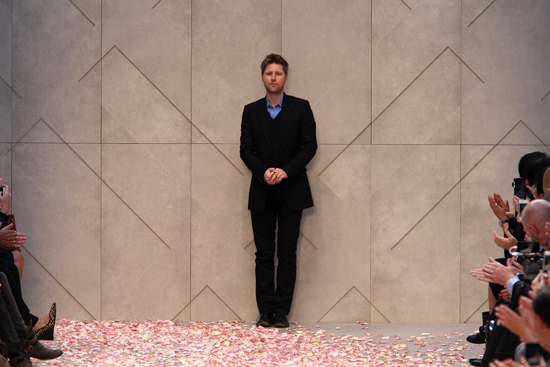
| Source: Getty / Antonio de Moraes Barros Filho |
Christopher Bailey's latest appointment as both Chief Executive officer and Chief Creative director of Burberry has caused a lot of controversy. As the decision was announced, it was reported that Burberry's stocks fell more than 7%. So why is there so much angst surrounding this decision?
Designers/creative directors/Chief Creative Officers have very limited power when it comes to management in the financial and administrative sense. I remember that I once heard Tom Ford say in an interview that when he first was appointed creative director of Gucci, one of the terms in his contract was that he would not be allowed to become the public face behind the brand. In fact, it was stated in his contract that he was not even allowed to make a public appearance at his shows for Gucci. Ford completely disregarded this clause in his contract and successfully transformed Gucci, a once struggling luxury brand, into what it is known as now. Between 1995 and 1996 sales at Gucci increased by 90%. During that period, in October 1995, Gucci went public with an IPO offering $22 per share. Although the label of Creative director implies limited power in regards to administration and management of Finance, Gucci allowed Ford the power to buy shares in other fashion companies (within reason). This enormous power instilled by Gucci into Ford, a rather risky move, proved to be extremely beneficial towards Gucci in the long term.
With a success story such as Tom Ford at Gucci, coupled with Christopher Bailey's already successful venture at Burberry. It is implied that Bailey should be able to further Burberry as a luxury retail brand into the 21st century. But, how realistic is this?
While Christopher Bailey has been instrumental in building Burberry from a small English brand known for their trench coats into an internationally recognised and highly coveted luxury retail brand, he has only been involved with the visual and creative aspect of this development. To be blunt, Bailey has not been involved with the commercial, financial and administrative aspect of the brand, in short, overseeing and managing the whole company. Until this day, Bailey has merely been involved with introducing new innovative concepts to the brand of Burberry, he has not been involved with the implementation of those concepts.
Furthermore, the two roles of Chief Executive Officer and Chief Creative Officer, have up until now, been viewed as two separate roles by Burberry for a reason. Bailey currently presents 6 collections a year; Resort, Spring Menswear, Spring RTW, Pre-Fall, Fall and finally Fall Menswear and as Chief Creative Officer, it is no doubt that he also oversees, Burberry's other two lines; Brit and London. It will simply been too much for Bailey to take up the role of Chief Executive Officer, alongside his already demanding duties of Chief Creative Officer.
Perhaps Bailey will prove himself in a role which many doubt he will succeed in. What ever the outcome, Bailey doesn't seem too confident about his new role as Chief Executive Officer in this video-
Furthermore, the two roles of Chief Executive Officer and Chief Creative Officer, have up until now, been viewed as two separate roles by Burberry for a reason. Bailey currently presents 6 collections a year; Resort, Spring Menswear, Spring RTW, Pre-Fall, Fall and finally Fall Menswear and as Chief Creative Officer, it is no doubt that he also oversees, Burberry's other two lines; Brit and London. It will simply been too much for Bailey to take up the role of Chief Executive Officer, alongside his already demanding duties of Chief Creative Officer.
Perhaps Bailey will prove himself in a role which many doubt he will succeed in. What ever the outcome, Bailey doesn't seem too confident about his new role as Chief Executive Officer in this video-
Sunday, October 6
Céline Spring/Summer 2014
Season after season Pheobe Philo has presented boxy-shapes, structured garments with fittingly appropriate palettes. During her time at Céline she has heavily re-invigorated the brand, taking it from a not-so-exciting monogrammed french luxury house, to being one of most coveted brands worldwide with a strong focus on both accessories and apparel. This season, Philo presented a collection which truly once again changed the way people think about Céline.
In this collection, there is still very much the essence of the Céline woman from seasons past, however, this season she was much bolder and daring than ever before. The collection was more lighthearted and the garments carried much more fluidity rather than the stiff-structured garments of seasons past. Yet structural silhouettes still very much appeared in this collection, however they were juxtaposed by a carefully selected print on a garment, which made the fabric carry a more fluent presence and personality. It was a tale of the old and the new. Often looks from the show would have a stiffened top half through the use of a t-shirt or coat, which would then be juxtaposed with the eloquence of a chiffon insert or skirt. This not only allows for movement to be carried throughout the whole look, from head to toe, but also is true of the chameleonic nature of the collection.
The latest offering by Phoebe Philo in Céline's Spring 2014 collection, described a tale of morality. Taking lessons from the past and applying them to the future.
Images from style.com. View the full collection here.
Chanel Spring/Summer 2014
Fashion and art was the focus of the the latest collection by Karl Lagerfeld at Chanel. There's always been a debate over whether fashion is art, personally, I believe that while fashion maintains some of the characteristics of art, I don't believe that fashion is entirely true when given the label of art. Lagerfeld very much played on this debate through this latest collection, as guests sat in the Grand Palais, they very much had to examine the difference between the faux art gallery and the garments presented. It challenged the viewers to not only form an opinion on this debate as they sat they were confronted by Lagerfeld visually. Ironically all of the artworks in the gallery were of course fake and created to be used in conjunction with the show. This choice by Lagerfeld is significant as he could have commissioned artists to capture the essence and heritage of the brand of Chanel through it's iconic No. 5 perfume, logo and Camellia flower among others. However, he chose not to. This decision insinuated his stance on the debate, perhaps fashion is the ironic or imitative sister of art.
The collection - as with all Chanel collections by Lagerfeld - centred around the heritage and history of the brand. Chanel, after all, is a house which praises and values it's heritage. Every collection seems to be a re-collection of the nostalgic years of Coco Chanel and of her achievements rather than focusing on the future of Chanel's role as a brand in the luxury retail industry. Depending on how Lagerfeld executes a show and collection, this usually falls into two categories, tiresome or invigorated. While it is of course respectful and desirable to acknowledge the origins of a brand, does Lagerfeld really need to do this with every single collection?
Dispensability really should be the focus of Lagerfeld's collections. Look at the collection in look-by-look and you'll notice that Lagerfeld has a habit of presenting 3 or 4 looks which feature the same materials, prints, colours or design. While some were scattered throughout the show, the pattern becomes increasingly apparent if you view the collection on a look-by-look basis and not in it's respective order. The collection totalled a number of 89 looks - unnecessary.
From tweed, to jersey, to lace and chiffon, Lagerfeld included them all in Chanel's Spring collection. The use of this huge variety of textiles whilst does show Lagerfeld's capacity to design with different textiles, seemed boisterous and unruly. While the colours used in this collection sprawled over continents, I'm not sure if Lagerfeld's goal is to design an entire wardrobe for a woman or just play with different textures and colours.
I've read everywhere that this collection focused on the 'modern' and 'contemporary', but with an unlikely assortment of colours, textiles and a total of 89 looks, Chanel's Spring 2014 collection proved to be once again a regression into Lagerfeld's fear of digressing from the heritage and authority of Chanel.
Images from style.com. View the full collection here.
Monday, September 30
Comme des Garçons Spring/Summer 2014
When reviewing any fashion show or simply viewing it, the audience must take a number of factors into consideration, knowledge in this instance holds power of critique. Firstly, the audience must have knowledge of the creative director's past work and their vision for the brand. Secondly, to familiarise themselves with the brand itself. Anyone who knows of the Comme des Garçons label is aware of the brand's aesthetics - that it is a brand which deals with the unconventional and avant-garde aesthetics within fashion. And so, for anyone who has not come across the work of Rei Kawakubo, it may be a shock to learn that Comme des Garçons has developed a cult following over the years simply because of it's rejection of the aesthetics of mainstream fashion.
The way in which Comme des Garçons manifests itself each season is something truly exceptional. It is always unexpected and distinctly different from the hundreds of collections presented every year. The mood at the latest collection was extremely dark for the most part. Even the pink and white garments still did not promote any light or brightness, it was still very much dismal. In the last few seasons for Comme des Garçons the garments have felt extremely conservative in the way that the garments have created a trapping around the model. These garments impose themselves onto the audience, they scream and demand that the audience's concentration of attention on them and them only. This collection was strict and disciplined in the sense of it's aesthetics and it's interpretation.
Yet Kawakubo's offering this season felt like a re-interpretation of seasons past. Instead of creating something entirely new, it felt as though it was an adaptation of the Comme des Garçons past collections and a re-issuing of their collections in a way which would conform to our social system nowadays. Although this collection did feel much more cleaner and pragmatic than past collections. It is also interesting to note that Kawakubo's offerings never feel wrong or awkward to a fashion audience. It's simply accepted and taken as another initiative as challenging the limitations of fashion and it's relationship with art. It all but seem's as if Rei Kawakubo in this world, can do no wrong. Perhaps it is because of the violent distress that each collection portrays in comparison to the other designers at Paris Fashion Week that Comme des Garçons and it's namesake is so readily praised in it's entirety.
Images from style.com. View the full collection here.
Sunday, September 29
Christian Dior Spring/Summer 2014
The past few seasons at Dior have proved that Raf Simons is not concentrated on re-creating or re-inventing silhouettes but instead, he has focused his attention the way in which the silhouettes are constructed.
As opposed to his last few collections both at Jil Sander and Christian Dior, this collection was much less refined and bearing the bones of the industry. This was both present in his set, decadent flowers hung from the ceiling and peaking through a builders scaffold, as well as his garments which contained unconventional cutting techniques and embellishments. Through the simple process of cutting in a different manner, Simons' was able to transform a traditional centred keyhole into a much less imposing ornamentation on a dress. It was clear that Simons' drew inspiration from his early 2000 menswear collections under his own brand, paying homage to his obsession with military uniformity. There was a feeling of unity and totality within the collection.
However some of the fabrics used lacked movement and thus, an understanding of the characteristics of the fabric themselves. This was interesting as his last few seasons, particularly the Spring 2013 collection, showcased beautifully draped metallic organza which moved down the runway in a way which broke the structural limits of such a textile. Simons is a designer who understands the importance of textiles - their strengths and limitations and so it was strange that he would make such a rookie mistake which left some of the models awkwardly shuffling down the runway.
The palette of Dior this season was much less ethereal as it was characterised by a much bolder and strengthened assertion on the audience, rather than dissipating into the grand scheme of things. Simons' is finally starting to assert his chosen identity for the brand of Christian Dior, rather than concerning himself with paying an homage to the past. Dior will only continue to progress forward as a more united distinction and assertion.
While the collection was easy on the eye, one thing that has proved to be a rather arduous task during Raf Simons' reign at Christian Dior is the casting of models in the runway shows. Strangely enough Christian Dior was not named and shamed in the letter that the Diversity coalition penned in regards to the Paris womenswear show, however Christian Dior does indeed appear on the Paris list published on the website.
6 models of colour and Asian descent is not deserving of the title of a diverse casting of models. This act by the casting director, creative director and the brand of Christian Dior, no matter what the intention, is racist and more importantly ignorant. There is no diversity that exists within showcasing one model of colour followed by 10 or so Caucasian models and one Asian model followed by another 10 or so Caucasian models and so forth. It is nonsensical to claim this cast as being diverse simply because of the presence of 6 models of Asian descent or models of colour as opposed to having none. It simply showed a lack of awareness and ignorance.
Images from style.com. View the full collection here.
Friday, September 27
Dries Van Noten Spring/Summer 2014
Amidst all the fuss and rapid rate of fashion week, Dries Van Noten's collections always seem to slow down the atmosphere as it encourages the audience to take time to reflect upon the madness that is fashion week. While there seem to be the two polar opposite aesthetics of excess and extravagance vs minimalism and reductivism, Dries Van Noten's latest collection perfectly contemporised the two.
Van Noten referenced the opulence and wealth of the overabundance atmosphere which the fashion industry portrays and pinned it against the impoverishment of those with less in his collection. Looking through the collection, it told a story which depicted the struggles of socio-economic classes both in the present, past as well as future. With each collection, Van Noten tells a story, it is not always marked by joy or happiness however, it always has a sense of purpose. This also pertains to his collections, they are incessantly commemorated by a sense of purpose, each piece is able to hold it's own against the beauty, styling, background and even the endlessly busy nature of fashion week.
Dries Van Noten re-defines the western doctrine of luxury and opulence, luxury should not be staged or boasted rather it should be understated and intrinsic. The embellishments of the gold pleating and hints of bead work on the tops and skirts, imply and hint at the luxurious nature of the Dries Van Noten woman. The structures of many garments are not tough and fixed, instead gentle and kind to movement, allowing freedom to the wearer as Van Noten wishes not to hold a distinction between the wearer and the garment. Instead granting the wearer and garment to develop a much more organic relationship.
Images from style.com. View the full collection here.
Friday, September 20
Prada Spring/Summer 2014
Miuccia Prada has always been a woman in fashion with distinctly directional aesthetics for her two brands, Prada and Miu Miu. This season for Prada proved to be no different, as Miuccia Prada's ability to express her words and opinions of social contexts through fashion design is unparalleled in the industry. The collection was intellectual yet, not entirely serious, it was comical in it's ability to take an assortment of unlikely colours and textures.
The use of prints on garments drew a reference of the propaganda used by Communism and was a reminder of Miuccia Prada's past role as secretary of the Milan Communist Party; it was a nostalgic resonance of the past and what is to come in the future. Miuccia Prada used the clothes and colours as a blank canvas to spread the propaganda of feminism and empowerment of women in the same that the Communists used the colour Red predominantly in their propaganda posters. These clothes acted in the same way as paste-ups on a wall, contending the role of women in today's society.
The opaque comical boldness of the colours, together with the designs, spread a message of the feminist movement juxtaposing the sonority with the great consequence of women today. Perhaps, her message for the world is the present occurrence of the new 'domino effect'. It is interesting that she utilised these references to Communism in such an empowering manner. This collection represented the utopian world and innovative nature created by the feminist movement, again, a play on the ideology of Communism - aiming for an achievement of utopia .
In some cases there is often blind praise for Prada because of its namesake, however this truly is a collection which challenges your understanding of fashion. The audience views one of two things from such a collection: pieces of material or a movement. To understand it as a piece of material, is simply fine however superficial and shallow in its capacity. To understand the collection as a movement, is one which gives life to both the viewer and the clothes, as well as facilitating that movement, the viewer becomes introduced to the collective of that movement, thus, creating an mutual commodity.
Prada has destroyed the boundary that is superficial nature of fashion that is blasé, and produced a collection which is radically seditious. This collection captures the essence of intellectual nature of fashion design.
The Prada look is after all, defined by its fashionably intellectual content.
Images from Style.com
Rodarte Spring/Summer 2014
"Inspired by L.A and California", let's stop there. Rodarte in the last few years has been a brand which is notorious for it's exploitation and questionable appropriation of Aboriginal art and factory workers in Ciudad Juárez, one of Mexico's most violent towns. The Mulleavy sisters somehow think that this is "edgy" however, in reality, a line has been crossed and this recent collection depicted their attempt to venture away from inappropriate appropriation. I honestly do not understand this recent desperate attempt of a collection by the Mulleavy sisters, to me it seems like a lot of leopard print with a motley assortment of so-called "edgy" designs. The collection as a whole feels extremely awkward and disproportionate when worn.
Although I understand that their vision of Rodarte to bring forward fashionably provocative pieces every season, this collection simply is fashionably inept. It was an ennui of looks which proved to be cheaper and inferior interpretations of Saint Laurent by Hedi Slimane.
Perhaps, Rodarte Spring/Summer 2014 is a representation of the Tumblr famous sensation known as "soft pastel grunge".
Images from style.com
Wednesday, September 18
The Business of Blogging Part 3 - Ethics
| Net A Porter's Fashion Blogger Magazine issue, Spring/Summer 2011 Source: http://insidefmm.com |
Personal style and style bloggers are taking the fashion industry by storm, many at the top have gained an international following with hundreds of thousands of followings across social media platforms such as Facebook and Instagram. Bloggers nowadays are entrepreneurs more than anything. We, readers, have an insatiable need to gain an inside into the luxurious and fast-paced world that is the fashion industry, as these fashion bloggers become increasingly popular, it makes you wonder if they'll eventually turn into one of those celebrities which you see promoting a new 'quick and easy' weight-loss method or in other words, simply sell out.
When I attended Industry day at Melbourne Spring Fashion Week, one woman brought up the point to Phoebe Montague of Lady Melbourne that she was confused what a fashion blogger was, she thought it was someone who shared their opinions and insights into the world of fashion. While personal style bloggers do often carry that aspect, I do believe it has somewhat been more or less corrupted.
Through a personal style blog, a blogger creates a community. It is a community dictated by conversation and an intimate relationship between viewer and blogger is established the conversation. It's essentially a source of organic media. I say this because to be a blogger, no one is really paying you - although some bloggers are now earning money but to monetize your blog, you eventually fall under the category of entrepreneur rather than blog. However, no one pays you to stay up until 1 am writing a review of a show that you have just attended and assembling your photos for a post. There is a trusting equilibrium balanced between viewer and editor of a blog.
It is of course not wrong nor is it corrupted when a blogger decides to monetize their blog in an ethical manner. Nonetheless, some bloggers seem to forget the importance of blogging ethically.
Most bloggers these days are ethical enough to state when they have been sponsored for a post or if they've received a PR gift or sample (and although sometimes that may be hidden in a small corner) it is still stated. However, when bloggers monetize their blogs simply for the money and do not provide a transparent attitude towards their blogging ethics, it becomes problematic.
One blogger I truly admire for their ethical and truthful approach is Ivania Carpio of Love-Aesthetics. While I'm sure everyone is truly in awe of her amazing minimal style, one of the reasons why her blog is so independent and successful is due to the fact that she is truly open and transparent to her readers about sponsored posts and 'advertorials'. She writes, "independence, editorial freedom and honesty are the core values of blogging. It's what makes (fashion) blogs so relevant and sets them apart from other mediums." This transparent attitude to monetizing her blog depicts her to the viewer as an approachable and honourable blogger.
After reading Ivania's brilliant ethics page, I came across the blog PR Couture and their shop. One of the many things I came across something called a "Fashion Media Bundle". Something about this simply didn't sit right and so I became increasingly curious and wanted to find out more. As I read on about the "Media Bundle" it stated the following:
"Snatch up more than 200 of the most coveted fashion editors and bloggers in the biz. You'll get 36 Print & Online Fashion Accessories contacts, 50 Fashion Blogger contacts, complete with social media links... with more than 100 editor emails for a cool $297"
Let's talk about this for a second. From what I can tell, you basically just get a list of email addresses and URL's to social networking platforms of fashion bloggers and editors. Their guaranteed promise however says absolutely nothing about establishing relationships through this media bundle but instead guarantees the accuracy of the list. Wow! For $297 what a bargain for all this information! It's not like I could simply search up Vogue and look up the emails for their senior fashion editors? I mean that's just simply impossible right.
This is simply manipulative and preying on the weak. It leads consumers (assuming their target demographic is fashion bloggers who have just started a fashion blog) to believe as though they are buying a media relationship and not simply a list of names and email addresses. But than again perhaps, that's the point. They're trying to sell the idea of an established relationship with some of the most internationally recognised fashion magazines in the world. Nevertheless, this is simply unethical. I feel sorry for those of you who are willing to fork out a ridiculous $297 for a list which you could put together yourself with some dedication, time and effort. This is also selling public knowledge. These email addresses are not private and are easily accessible by anyone who knows what they're looking for as well as where to look.
I must disclaim that I have not seen this "Fashion Media Bundle" and so am not sure if it simply is a list of names, emails and URL's however, if you're willing to throw $297 away, be my guest!
This is simply wrong. It's unethical and it's deceitful.
Inevitably a fashion blog is concerned with it's readership and establishing a relationship with them. For this reason, transparency and honest are two of the most ethically valuable principles of a fashion blogger.
Sunday, September 15
Final thoughts on Kara Liu and Jason Alexander Pang
It's so rare to have the opportunity to chat to a designer who is still organic and has not yet been influenced by the pressures of production and the notion of excess is better, there is a certain sense of transparency in well-established and serious emerging designers that many of the top designers in the world have unfortunately lost. Kara herself told me that right now, her and Jason are just both trying to establish a name for themselves in the fashion industry and that right now, it's not about money. Nonetheless, she and Jason both recognise the importance of generating a revenue in the long term to be sustainable as a brand and creative force in the industry.
I asked them both what stores they would like to see stocking their respective brands in Melbourne and Kara replied "Green with Envy" and Jason, "General Pants" (although I still think that he could definitely go for Marais - I believe that sort of demographic would respond extremely well to his brand). It shows that these two designers are not just your typical self-proclaimed "passion for fashion" designers, but instead through their brands they are trying to say something and present something unique to present to the fashion industry.
Jason listed his influences as Givenchy by Riccardo Tisci, Mary Katrantzou and Dries Van Noten among others and Kara, Céline by Phoebe Philo, Jil Sander (presumably by Raf Simons as well as Jil Sander herself) and Marques Almeida. Their influences are extremely obvious in their work if you are familiar with the designers' but at the same time, their work is far from being a copy of their influences' work. It was interesting that Kara listed Marques Almeida as being one of her influences as it shows that she is not simply a clean-cut minimalist designer - she is also fascinated with deconstruction, which once again displays her knowledge and want to truly know the fabrics she chooses for each collection.
They both have strong ethics attached to their fashion brands and they also truly believe in their brands. I have a lot of respect for both of them to try and establish themselves in an industry which is notorious for habitual scepticism at a time when fashion is struggling with it's identity of quality vs. quantity.
I was so fortunate to have had the opportunity to meet both Jason and Kara, they are both idealistic young designers with so much to offer the fashion industry.
Thank you both so much for having me and welcoming me into your showroom. I was extremely honoured to have had the opportunity and it was inspiring to have met you both. I wish you all the best in the future and encourage you both to keep progressing and growing as designers. I look forward to meeting both of you again!
To view more of Kara's work head over to her website and head over to the AM.XANDER website for Jason's work.
I asked them both what stores they would like to see stocking their respective brands in Melbourne and Kara replied "Green with Envy" and Jason, "General Pants" (although I still think that he could definitely go for Marais - I believe that sort of demographic would respond extremely well to his brand). It shows that these two designers are not just your typical self-proclaimed "passion for fashion" designers, but instead through their brands they are trying to say something and present something unique to present to the fashion industry.
Jason listed his influences as Givenchy by Riccardo Tisci, Mary Katrantzou and Dries Van Noten among others and Kara, Céline by Phoebe Philo, Jil Sander (presumably by Raf Simons as well as Jil Sander herself) and Marques Almeida. Their influences are extremely obvious in their work if you are familiar with the designers' but at the same time, their work is far from being a copy of their influences' work. It was interesting that Kara listed Marques Almeida as being one of her influences as it shows that she is not simply a clean-cut minimalist designer - she is also fascinated with deconstruction, which once again displays her knowledge and want to truly know the fabrics she chooses for each collection.
They both have strong ethics attached to their fashion brands and they also truly believe in their brands. I have a lot of respect for both of them to try and establish themselves in an industry which is notorious for habitual scepticism at a time when fashion is struggling with it's identity of quality vs. quantity.
I was so fortunate to have had the opportunity to meet both Jason and Kara, they are both idealistic young designers with so much to offer the fashion industry.
Thank you both so much for having me and welcoming me into your showroom. I was extremely honoured to have had the opportunity and it was inspiring to have met you both. I wish you all the best in the future and encourage you both to keep progressing and growing as designers. I look forward to meeting both of you again!
To view more of Kara's work head over to her website and head over to the AM.XANDER website for Jason's work.
KARA LIU Fall/Winter 2014
Kara Liu is an extraordinarily meticulous designer. After having interned for Alexander Wang, she is back in Melbourne to present her latest collection. Kara's design aesthetic was minimalist yet not entirely simplistic. Her collection featured beautifully crafted garments with exceptional attention to detail. Her freedom and independence from so many other minimalist designers in the world is marked by her precise accordance with details - whether it be concept, production or presentation, Kara is a designer of distinction.
The Fall/Winter 2014 collection featured a bold yet soothing palette of colours which, in turn, provided a succession between the fabrics, textures and fluidity of her designs. Kara's work is concerned with textures and unparalleled subtle detailing. Her ability to transform simple basic pieces in any woman's wardrobe into sensory stimulating mediums by deconstructing traditional texture and textile relationships - this is what concretes her progression as a designer. Kara understands her textiles in a way which few designers do - she understands the structural and fluid limitations of some fabrics and takes full advantage of the strengths of her chosen textiles.
Apart from being a designer of distinction, Kara Liu is one of intelligence as well. Her designs capture not only the brand that she wants to present to the fashion industry but also one which is of her own; her own persona. She is a smart and savvy designer who is able to qualitatively recognise the strengths and limitations of any concept and ideology. As a designer, Kara has an extremely candid vision for both her brand and the 'Kara Liu woman'. She wanted her Fall/Winter 2014 not to hold a monopoly of their own in one's wardrobe however have the quality to be able to easily integrated into one's wardrobe to create a unity between their existing pieces and pieces by Kara Liu. This in particular, is something that I have never ever heard a designer say before. More than anything, Kara wants her buyer and consumer to have the ability and freedom to shape their style with the assistance of Kara Liu garments.
The KARA LIU label is defined by it's practical intelligence yet fashionable patronage. Kara has been able successfully translate her own persona onto the garments - her brand is not only one which bears her name but truly encapsulates the spirit of Kara Liu.
Make sure you all visit Kara's website and like her facebook page as I'm sure she we will be seeing much more of her work in the future.
Saturday, September 14
AM.XANDER Spring/Summer 14
Yesterday I was invited to the showroom of KARA LIU and AM.XANDER's 2014 collections and I had the absolute pleasure of meeting two extremely creatively and conceptually elevated passionate designers, Kara Liu of KARA LIU and Jason Alexander Pang of AM.XANDER. As graduates from Melbourne's prestigious fashion institution, RMIT, they both have strong directional aesthetic envisioned for their respective brands.
I'll be featuring their collections separately, first up is AM.XANDER Spring/Summer 2014.
AM.XANDER by Jason Alexander Pang
Following an internship with one of fashion's most respected print mavens Mary Kantrantzou, Jason launched his Spring/Summer 2014 collection and it is nothing short of astounding.
Jason manages to perfectly encapsulate high fashion menswear and street menswear thus, offering a dynamic equilibrium between the two. He wanted to strip down the culture of print in the fashion industry - taking it away from the floral plague and regress it back to the basics. Jason's work contends the interplay of commercial, approachable fashion with the innovation and progression extended by high fashion labels. Although his work is primarily concentrated on prints, he equates prints with surpassing detailed tailoring and textiles.
His Spring/Summer 2014 collection featured a collection of prints that were each more individualistic, futuristic and culturally relevant than the one before. The basis of his prints were inspired by the male dominated sci-fi gaming culture of modern day society. The contrasting notions of rawness and liquidity between his prints and textiles provided the perfect basis for the consumer of his garments to be worn without extreme extravagance and flamboyance. The relationship he develops through his collection with his consumer is a rare one as he portrays modern culture and values of society in a specific time frame through his garments, his consumer is ultimately wearing the past, present and future.
The fabric composition of his collection, polyester, is a choice which demonstrates his mature understanding of fashion as a designer. Working primarily with a medium of print on garments, Jason is able to recognise the importance of textiles and the importance of be able to advance the longevity of his garments.
AM.XANDER is a label which recognises and bridges the menswear gap between candid street wear and high fashion which represent the two notions of commercialisation and conceptualisation, while exploring the necessitated respects of today's society.
AM.XANDER is a true and honest representation of the democratisation of fashion.
To view more of the AM.XANDER Spring/Summer 2014 collection head over to the website and make sure you all like the facebook page aswell!
Thursday, September 12
Altuzarra Spring/Summer 2014
Altuzarra's collection was much more interesting, it was nice to see that he branched out of his usual fuss-free aesthetic that he's most comfortable designing. While the collection did still carry many interpretations of this aesthetic, I found the collection to be anticipated for a younger and more constraint audience than his previous collections. Yet this collection still lacked defined innovation for the Altuzarra label. With a name like Altzuzarra, I expected nothing short of raw and edgy, pieces of clothing which would be able to impose their opinion on the audience.
There was nothing new or unique about the silhouette of the garments and the tousled fabric over the waists of skirts seemed messy and unnecessary. Thus, the entire collection appeared to be an unruly assortment of ideas.
Nonetheless the velvet used to create many of the skirts, was accentuated beautifully by the drapery and tousled nature of it's use however, I'm not too sure how appealing this would be to accentuate this area of the body. It was perhaps nostalgic of the infamous Comme Des Garçons Spring/Summer 1997 collection often referred to as Lumps and Bumps in which Rei Kawakubo aggressively and shockingly challenged the traditional perceptual boundaries of the female form, volume and space.
Subscribe to:
Posts (Atom)