Friday, November 22

Fashion News: Some Things You May Have Missed...

So while I was busy studying super super hard for my exams, so many things happened! I thought I would just take an opportunity to cover just some of the many things that you may have missed in my absence! Perhaps, I may even make this a weekly thing!


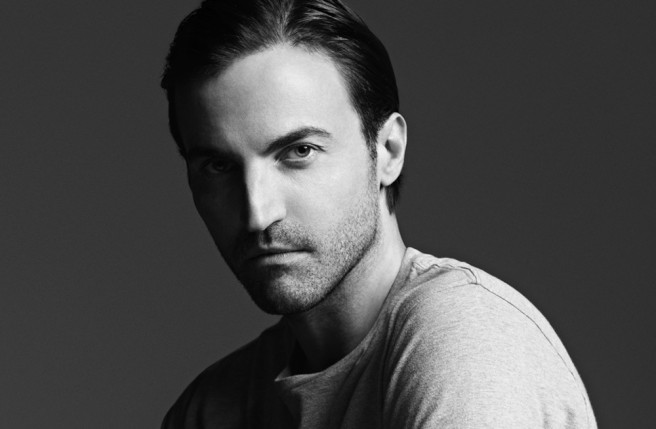
Nicolas Ghesquière photographed by Karim Sadli
Source: Business of Fashion


Nicolas Ghesquière appointed Creative Director of Louis Vuitton.

All the speculation paid off! In my eyes, this really is a better fit for the brand as Louis Vuitton continues to re-brand itself to stay current, modern and fresh. Ghesquière is personally, one of my all time favourite designers. He knows how to design and he knows how to do it well. More importantly, Louis Vuitton in the last few years is trying to stray away from it's monogrammed culture. Louis Vuitton under the creative control of Ghesquière will no doubt provide a new and improved platform of creative expression for both the house and Ghesquière himself. Also now that Ghesquière is working for LVMH, Bernard Arnault will no doubt provide the resources to fight the lawsuit which PPR (the luxury conglomerate which owns Balenciaga) initiated against Ghesquière. Now it just seems like a bad idea on PPR's behalf because we all know LVMH is much more powerful and it's resources are much more widespread than PPR. So a big congratulations to Nicolas Ghesquière and I'm sure many are eager to see his debut collection at Louis Vuitton.

Sarah-Jane Clarke and Heidi Middleton's resignation as directors of Sass & Bide. 

In all honesty, I really wasn't surprised at this news. Ever since Myer bought shares in Sass & Bide, the company has become more and more commercial - they've recently expanded into lingerie. When a chain department store as big as Myer has it's eyes set on a company, it's not because they really 'believe' in the brand, but rather because they know that the brand can become commercially accessible and become a source of revenue. Sass & Bide now will be a company aimed at mass appeal rather than creating designs as a source of creative expression. However that's not to say that Clarke and Middleton won't have any control of the brand, they will be staying on as brand director and creative director of Sass & Bide as well as being the public ambassador's of the brand.

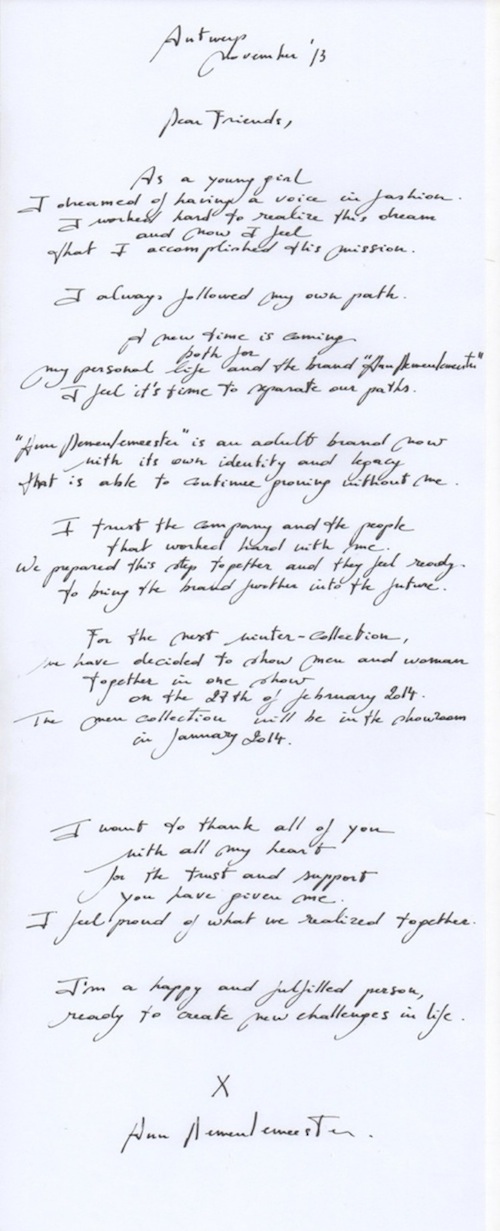
Ann Demeulemeester leaving her eponymous label.

I first heard about this at about 2:50am today (right after seeing the midnight premiere of The Hunger Games Catching Fire) and honestly I don't know if it was the fact that it was nearly 3 in the morning and I had been running around all day or something else but my heart honestly sunk when I read the email from Business of Fashion announcing her exit. Demeulemeester's exit is sad in itself but also when viewed in the larger sense represents the changing landscape of the fashion industry on a global scale. Of course she will never be replaced, no matter who next holds the helm at her eponymous label, the label will never be the same and the die-hard Demeulemeester fans all know that. She is one of the infamous Antwerp Six, starting from humble beginnings, Demeulemeester has successively transformed her previously underground dark romantic aesthetic into one which is now embraced by so many in the fashion industry (Read: Mining the Goth Aesthetic, Fashion Pivots to Darkness). In my opinion, there are two types of designers; the first is the one which just makes pretty clothes - sticks to the status quo and the second which is revolutionary - challenges the audience's preconceptions. Demeulemeester is one of those rare designers who are truly revolutionary.

Read the letter she has penned regarding her exit here.

Kit Willow pushed out by the Apparel Group from Willow.

Money, Greed or simply a misunderstanding? I'm honestly not too sure what's happening there. The Apparel group owns Saba and Sportscraft - two well-respected brands within the Australian fashion industry, however they're really nothing too revolutionary or anything we haven't seen before. Willow however, is the most influential label which the Apparel Group owns. It's extremely hard in the fashion industry to stay true to one's oeuvre, especially in the Australian fashion industry where it is hard to succeed because up until a few years, we've cherished our mass-appeal and commercial brands more than anything. Australia as a nation is quite lazy? I suppose that's a good way to describe it. We're constantly behind in trends and new developments in industries whether it be the fashion industry or technology. It's always sad to see a designer pushed out of their own label that they've grown and one which bears their name - it's very much a David and Goliath situation. However, I doubt that anything too drastic will happen to the Willow label in the coming years. The whole incident will simply be brushed under the carpet as by the Apparel Group as they strive to reach new goals and sales targets for the Willow label.

Uniqlo sets it's sights on Melbourne.

Uniqlo has set a goal to become the number fast retailing company in the world. As it stands today, it is currently #4, after Zara, H&M and GAP. Currently Uniqlo holds an impressive brand portfolio of J-Brand, Helmut Lang, Comptoir des Cotonniers among others. Uniqlo is one of the stores I truly admire in the fast-retail industry because of it's strong sense of identity and direction. Uniqlo has an impressive Corporate Social Responsibility program, one of which puts companies such as H&M and Primark to absolute shame. One of the programs they've recently put to use is their Grameen initiative - they give back to the people and in particular women of Bangladesh, one of the countries exploited by textile manufacturing by companies such as Primark and H&M after the factory collapse in November of last year. Uniqlo has ventured into global expansion by two major factors; organic growth and quality in both their products and services. Uniqlo is a company which is truly Japanese in the core of their business model but is also successively expanding and adapting to the conditions of a global economy.

Thursday, November 21

A Conversation with Georgina Santiago


Georgina Santiago is a creative visionary like no other - to describe her as purely a fashion designer would completely be an understatement. Instead Santiago bears the label of a visual artist and color and trend forecaster.  Santiago's work is truly unique. Her two collections, Vitrine and Minutiae, are two which deal with pure, raw beauty of the human body and foreign intervention by alteration and manipulation. She is daring, challenging and inspiring.

Here she talks about colour, aesthetic, beauty as well as the two genres of fashion and art.

Q: A lot of your work encompasses the aesthetic of the beautifully disturbing, why is it that you find this particular aesthetic fascinating and explore it in the creative medium of fashion – a medium that by definition is associated with variations of beauty. How do you define beauty as an aesthetic and perhaps, a platform for discussion?

A: Beauty which disturbs is much more interesting than the “plain” beauty. It holds a special power – the ability of excogitation, to really challenge others to think.

I believe beauty has much more to say than to just propose a universal standard of beauty. It has the ability to carry much more depth and extend further. A certain form of ugliness has the ability to give beauty more depth and an element which brings it to the next level. In my opinion this particular aesthetic is truly satisfying once you have passed its first impact, which is kind of sour, however, it gets addictive, and eventually you are consumed, leaving you wanting more. At least it sticks to your memory much more than a simply “nice” image – which you probably will forget.

I have always been curious about people’s subjective tastes. Why is it that someone would love something and others would hate it? We all have some opinions without reason, but we are completely sure about them; we justify them as a part of our subjectivity. That is why it is always going to be a platform of discussion, because beauty is a social statement.

Although you’ve been formally educated as a fashion designer, you never refer to yourself exclusively as a designer, rather as a visual artist. Does the label of a designer perhaps provide somewhat creative boundaries or limitations to you as an artist?

Yes, I do think so. I am more interested in analysing, forecasting and collaborating in the aesthetics that society creates apart of its own identity, rather than solving problems, which I believe design must do. Design contributes to the aesthetics of an era. At first glance, design provides the solutions to a problem, and then communicates the appropriate aesthetic. This is why I don’t see myself as a designer, because I am more focused in the latter.

The two genres of art and fashion have never co-existed in a peaceful state. Some believe that fashion is not art and that art is not fashion on the basis that the wearability and pragmatism of each genre differs from the other. Do you believe there is a definitive answer as to whether fashion and art are able to co-exist as each-other? What is your opinion on the coexistence of fashion and art? Do you believe fashion is art or that art can be fashion?

I do believe that fashion can be art. However, that does not mean it necessarily is. Personally, I believe that there are three kinds of fashion.

The first is the type which exists on runways. This can definitely be art however not all runway fashion is art. Some of them are extremely luxury orientated. The second is the art that creates forms around the human body, in a sculptural sense, which is placed in museums (or more art-y runaways). This one is much closer to art. And the last one is fashion in the streets. It is the one which defines the parameters of fashion of a particular era. Personally, I believe that this is the one which is much closer to design, but at the same time the one that is much closer to art, because of its social aspect. These three kinds of fashion conjoined are cyclical; the last one is the starting and ending point. In my opinion fashion and art will definitely always feed each other.

Some would associate your work with minimalism because of the simplistic nature of your garments, however, would you rather label your work as challenging surrealism?

I am not sure if I would label it as a definitive definition, but it some ways it could be challenging surrealism. While I am working on it, I of course, think about pure forms, as minimalism encourages. A clear message, given by visual shapes that capture the attention for its simplicity, as an easy reading message, is a must to explain abstract and difficult concepts.

Personally I believe that sometimes trends in fashion can be a waste of money, that they are only beneficial towards marketing products and creating a sense of hysteria among consumers for the sole reason of generate a profit. It is why I much prefer to use the term aesthetic, as it holds a much liberal philosophy – it encourages people to become subjective about the trend or aesthetic. What do you think about my opinion? Do you believe that there is a distinction between trends and aesthetics in art, design or fashion?

I agree to an extent, however at the same time I don’t think trends are created for consumerism. I think trends would exist regardless of consumerism. Trends are an intrinsic aspect of society, as there are synergies between humans. At the same time, the fashion industry does take advantage of this, and accelerates the process and life of a trend. Aesthetics are much more general, and trends are not always aesthetic trends.


Minutiae and Vitrine both address the human body as a canvas or medium of creative expression. Although Minutiae portrays the body in a ‘sinister’ light, and Vitrine contends the mutation of the human body. Both of these carry negative connotations, however in both collections, your work not only accentuates the beauty of the human body but discredits the negative implications of cynicism and alteration. In the grand scheme of things, do you believe that perhaps sometimes the human body is taken for granted and we are not appreciative of its beauty?

I think I am so focused on the body because it is the material that we are made of, our shape, our physical aspect. The creation of an entity. How nature has decided us to be.

Furthermore, it has been on my mind, the way in which society perceives the female body to be beautiful. I have always hated this sort of “alteration”. For instance, the more sensual the female body is portrayed, the more beauty conveyed. For me, these are stupid equalisations which society has built, and I criticise them in my work. I would never present a woman in a sensual or glamorous way.

Through your projects Minutiae, Vitrine and the C&A design challenge; it becomes apparent that colours are extremely important to you. The palette of your work is very much focused on soft, pastel colours. Although in your design for the C.A. design challenge, you encompassed a rather vivid pink colour, you hid that away under the pleats of the garments so that its existence was dependent on the presence of light. The colours that you choose are always soft and aesthetically pleasing, never harsh when juxtaposed with your works Minutiae and Vitrine, do they perhaps provide a sense of balance between the unpleasant and the pleasant? Why do you believe colours are so important and powerful?

You are right, and I actually don’t choose those colours for this reason, but because they tell me something and in some cases are related directly to the concept, like in Minutiae.

I am a completely passionate about colour, and my language is colour. The fact that it is an aspect which every single thing in life bears makes it so powerful, and also the abstract side of it is so intriguing. It's communicative power is awesome; a colour has the ability to convey as much as an image does sometimes, and what it conveys is all socially constructed. The fact that colours are symbols is so amazing, given that humans have a really bad colour memory. I just love it!

As an artist, who is a person/(s) that you have the most admiration for and why?

I admire all the creative people that had done something meaningful. From Yves Klein, through Martin Margiela, to Lady Gaga. I could say so many...

Are you perhaps interested in branching out into transdisciplinary design, as trend analyses embraces a range of different artistic and design disciplines and your collections both involve the biological aspect of the human body?

Yes, definitely! I love all kinds of design, art, and creative forms, all manifestations of aesthetics. My aim is to work with something in between all of them.

Can you tell us about your next project? What does it involve and what are you intentions for it?

My next project is born from the Tumblr I have been curating for more than 3 years already, magneticum.tumblr.com. It is a selection of creative things which I have found interesting and aesthetically innovative.

I once said that my aim in life was to be inspired and inspire others – so I decided to make it happen. I am expanding my Tumblr to a website by adding more categories as well as more content to become a real source of inspiration for creative minds. Now magneticum will be an insight into my next project, theinspirationprovider.com. It’s exactly what I want to be, an inspirer.


Tuesday, October 29

Hi everyone!

So you may have noticed that there has been a complete lack of posts within the last month or so, I'm so sorry about that! I'll also be taking a short hiatus from today (29th Oct) until 18th Nov as I have my final high school exams.

I promise as soon as I finish my exams, I'll be blogging obsessively non-stop! So check back during mid-November, I have some really great and exciting posts planned for Sassy & Hip!

Have a great day and thank you so much for reading my blog!

Adeline xxxx

Wednesday, October 16

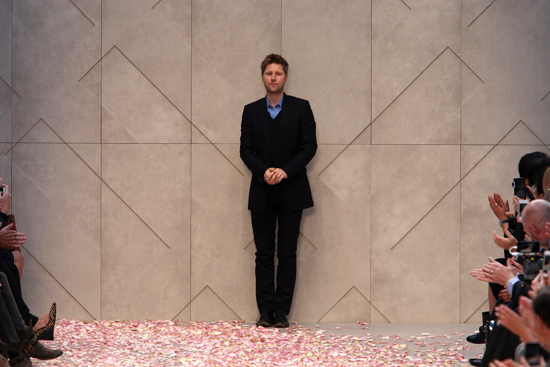
Christopher Bailey's reign over Burberry

Source: Getty / Antonio de Moraes Barros Filho


Christopher Bailey's latest appointment as both Chief Executive officer and Chief Creative director of Burberry has caused a lot of controversy. As the decision was announced, it was reported that Burberry's stocks fell more than 7%. So why is there so much angst surrounding this decision?

Designers/creative directors/Chief Creative Officers have very limited power when it comes to management in the financial and administrative sense. I remember that I once heard Tom Ford say in an interview that when he first was appointed creative director of Gucci, one of the terms in his contract was that he would not be allowed to become the public face behind the brand. In fact, it was stated in his contract that he was not even allowed to make a public appearance at his shows for Gucci. Ford completely disregarded this clause in his contract and successfully transformed Gucci, a once struggling luxury brand, into what it is known as now. Between 1995 and 1996 sales at Gucci increased by 90%. During that period, in October 1995, Gucci went public with an IPO offering $22 per share. Although the label of Creative director implies limited power in regards to administration and management of Finance, Gucci allowed Ford the power to buy shares in other fashion companies (within reason). This enormous power instilled by Gucci into Ford, a rather risky move, proved to be extremely beneficial towards Gucci in the long term. 

With a success story such as Tom Ford at Gucci, coupled with Christopher Bailey's already successful venture at Burberry. It is implied that Bailey should be able to further Burberry as a luxury retail brand into the 21st century. But, how realistic is this?

While Christopher Bailey has been instrumental in building Burberry from a small English brand known for their trench coats into an internationally recognised and highly coveted luxury retail brand, he has only been involved with the visual and creative aspect of this development. To be blunt, Bailey has not been involved with the commercial, financial and administrative aspect of the brand, in short, overseeing and managing the whole company. Until this day, Bailey has merely been involved with introducing new innovative concepts to the brand of Burberry, he has not been involved with the implementation of those concepts.

Furthermore, the two roles of Chief Executive Officer and Chief Creative Officer, have up until now, been viewed as two separate roles by Burberry for a reason. Bailey currently presents 6 collections a year; Resort, Spring  Menswear, Spring RTW, Pre-Fall, Fall and finally Fall Menswear and as Chief Creative Officer, it is no doubt that he also oversees, Burberry's other two lines; Brit and London. It will simply been too much for Bailey to take up the role of Chief Executive Officer, alongside his already demanding duties of Chief Creative Officer.

Perhaps Bailey will prove himself in a role which many doubt he will succeed in. What ever the outcome, Bailey doesn't seem too confident about his new role as Chief Executive Officer in this video-